

Complete EV Charging Safety Solution: AC & DC Leakage Protection with IVY METERING
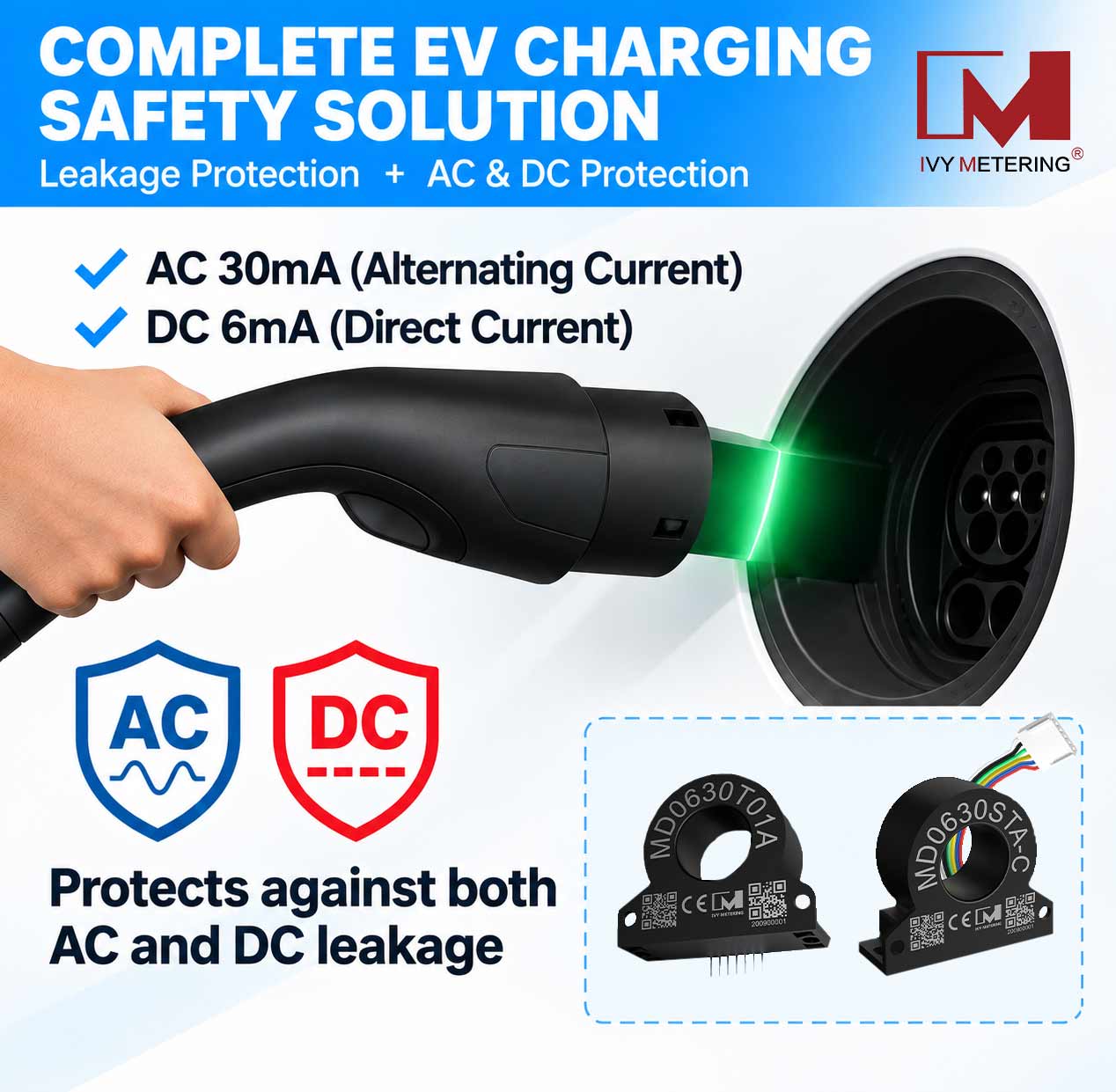
Complete EV Charging Safety Solution for AC and DC Leakage Protection
As electric vehicles become more widely used, EV charging safety has become an important part of charger design. An EV charging system may encounter both AC residual current and DC leakage current, so monitoring only one type of leakage may not provide the required level of protection for the charging system.
IVY METERING provides AC/DC leakage detection and residual current protection solutions for EV charging equipment. These solutions are designed to detect leakage current, provide alarm signals and integrate with the control system of an EV charger.
The product portfolio includes the MD0630T01A AC/DC Leakage Sensor and MD0630STA-C AC/DC RCD, providing different approaches to AC/DC leakage detection and alarm functions.
Why AC and DC Leakage Detection Matters in EV Chargers
An EV charger can contain power electronics and DC components that make residual-current monitoring more complex than conventional AC applications.
A complete EV charging safety architecture may therefore need to consider:
AC residual current detection
DC leakage current detection
Leakage alarm output
Self-test functions
Communication with the main control system
Integration into the EV charger's PCB and electrical protection system
The safety solution shown in the product material highlights AC 30mA and DC 6mA protection levels for EV charging applications.
MD0630T01A AC/DC Leakage Sensor
The IVY METERING MD0630T01A is an AC/DC leakage sensor designed for applications requiring measurement, alarm detection and digital communication.
The sensor supports:
DC leakage current measurement: 2–15 mA
AC leakage current measurement: 3–100 mA
DC accuracy: ±0.2 mA
AC accuracy: ±0.3 mA at 25°C
It provides three alarm output modes: DC alarm, AC alarm and AC/DC alarm. The alarm value can be programmed according to the application requirements.
The MD0630T01A also integrates a UART communication interface with Modbus protocol, allowing AC/DC leakage data to be read by the host controller. Its pin configuration includes UART RX/TX and separate AC, DC and AC/DC leakage alarm outputs.
The sensor uses a compact integrated design and supports PCB, pin and vertical installation, making it suitable for different EV charger internal layouts.
Key features of MD0630T01A
AC and DC leakage current measurement
DC measurement range of 2–15 mA
AC measurement range of 3–100 mA
Programmable alarm value
AC, DC and AC/DC alarm outputs
UART communication
Modbus protocol
PCB, pin and vertical installation
Operating temperature: -25°C to +80°C
The product documentation lists applications including AC/DC EV charging, solar systems, DC screens, fire distribution cabinets, medical CT equipment and long haul mining machines.
MD0630STA-C AC/DC RCD
The MD0630STA-C is an AC/DC residual current detection solution designed for applications where a simpler alarm-oriented architecture is preferred.
It supports:
DC leakage current measurement: 2–15 mA
AC leakage current measurement: 3–100 mA
DC alarm range: 3–6 mA
AC alarm range: 15–30 mA
Unlike the MD0630T01A, the MD0630STA-C uses an open-collector alarm output and includes a self-test function. The product is designed for cable or horizontal installation.
This makes the MD0630STA-C suitable for EV charger designs where the main controller primarily needs a leakage alarm signal rather than full digital leakage data communication.
MD0630T01A vs. MD0630STA-C
The two products address similar AC/DC leakage detection requirements, but their interfaces and functions are different.
| Feature | MD0630T01A | MD0630STA-C |
|---|---|---|
| AC leakage measurement | 3–100 mA | 3–100 mA |
| DC leakage measurement | 2–15 mA | 2–15 mA |
| AC/DC alarm | Yes | Yes |
| Programmable alarm value | Yes | No |
| UART / Modbus | Yes | No |
| Self-test | — | Yes |
| Alarm output | Digital signal | Open collector |
| Installation | PCB / Pin / Vertical | Cable / Horizontal |
| Operating temperature | -25°C to +80°C | -25°C to +80°C |
The most important difference is therefore the system integration method: MD0630T01A is designed for applications requiring leakage data communication and programmable alarm functions, while MD0630STA-C focuses on leakage detection, alarm output and self-test functionality.
Applications of AC/DC Leakage Protection
IVY METERING AC/DC leakage detection products can be used in a variety of electrical and power-electronic applications, including:
EV Chargers
Monitor AC and DC residual current in EV charging equipment and provide leakage alarm information to the charger control system.
Solar Energy Systems
Support AC/DC leakage monitoring in solar power and power-conversion equipment.
DC Screens and Distribution Cabinets
Provide leakage detection for DC electrical systems and distribution equipment.
Medical Equipment
The product documentation identifies medical CT equipment as one application area.
Other Industrial Equipment
The listed applications also include long haul mining machines and other electrical systems requiring AC/DC leakage monitoring.
Choosing the Right AC/DC Leakage Protection Solution
When selecting an AC/DC leakage sensor for an EV charger, engineers should consider several factors:
Detection range – Determine the required AC and DC leakage measurement range.
Alarm requirements – Decide whether the system needs fixed or programmable alarm thresholds.
Communication – For systems requiring leakage data through the main controller, a UART/Modbus interface can be useful.
Installation space – PCB, pin, vertical, cable and horizontal mounting options may affect the product selection.
Self-test requirements – Applications requiring a dedicated self-test function can consider the MD0630STA-C.
Controller interface – Check whether the charger controller requires digital signals, open-collector outputs or serial communication.
Conclusion
Reliable AC/DC residual current detection is an important element of EV charging safety. A suitable leakage monitoring solution can help EV charger manufacturers detect abnormal AC or DC leakage conditions and integrate corresponding alarm functions into the charging system.
IVY METERING MD0630T01A provides AC/DC leakage measurement, programmable alarms and UART Modbus communication, while MD0630STA-C provides AC/DC leakage detection, self-test and open-collector alarm output.
For EV charger manufacturers, electrical equipment designers and system integrators, these two products provide different approaches to implementing AC and DC leakage protection and monitoring in modern charging and power-electronic systems.


