

RCD Solutions for EV Charging Stations: Ensuring Safety and Compliance
RCD Solutions for EV Charging Stations: Ensuring Safety and Compliance
Safety Challenges in EV Charging
With the rapid expansion of electric vehicle infrastructure, safety has become a top priority. EV charging stations operate at high voltages and currents, making leakage protection essential.
This is where Residual Current Devices (RCDs) play a crucial role in protecting both users and equipment.
What is an RCD in EV Charging Systems?
An RCD (Residual Current Device) is designed to detect imbalance between live and neutral currents. When leakage is detected, the device quickly disconnects the circuit to prevent:
Electric shock
Equipment damage
Fire hazards
In EV charging applications, RCDs must handle more complex leakage scenarios, including DC residual currents generated by vehicle power electronics.
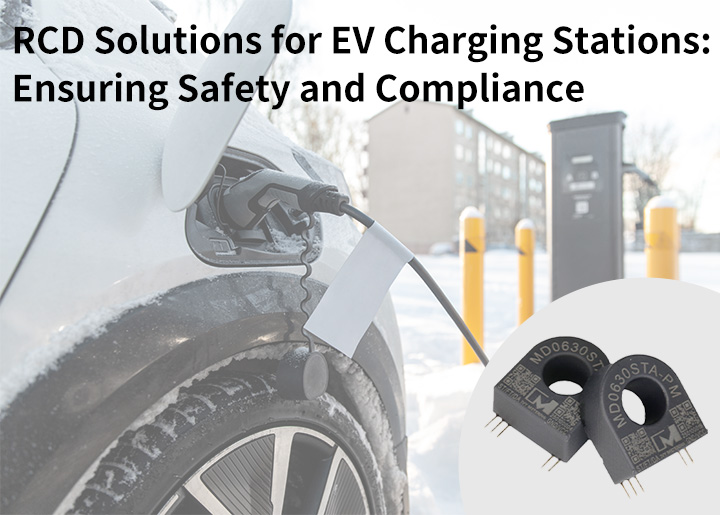
Why RCD is Critical for EV Chargers?
Protection Against DC Leakage
EV chargers can produce smooth DC leakage currents. Standard RCDs may fail under such conditions.
Advanced RCD solutions for EV chargers support:
Type A + 6mA DC detection
Type B options for higher safety requirements
Compliance with International Standards
Modern EVSE systems must comply with regulations such as:
IEC 62955
IEC 61008 / 61009
Using a compliant RCD ensures your charging station meets global safety requirements.
Key Advantages of Advanced RCD Solutions
Fast and Accurate Detection
High-sensitivity detection ensures rapid disconnection in case of leakage, minimizing risk.
High Reliability in Harsh Environments
Designed for outdoor and industrial use, RCD modules offer:
Stable performance under temperature variations
Strong anti-interference capability
Long service life
Compact and Easy Integration
Modern RCD modules are optimized for EV charger design:
Small footprint
PCB or modular integration
Easy installation and maintenance
Typical Application Scenarios
RCDs are widely used in:
AC home charging stations (Wallbox)
Commercial EV charging piles
DC fast charging systems
Portable EV chargers
Smart charging infrastructure
They are essential wherever user safety and compliance are required.
Supporting Smart & Safe Charging Networks
With the rise of intelligent EV charging systems, RCDs are evolving to support:
Real-time monitoring
Fault signal output
Integration with control systems
This enables smarter diagnostics and improved system safety.
Conclusion
As EV charging infrastructure continues to grow, the importance of reliable leakage protection cannot be overstated.
A high-quality RCD not only ensures compliance with international standards but also protects users and equipment, making it a critical component in every EV charging station.


